
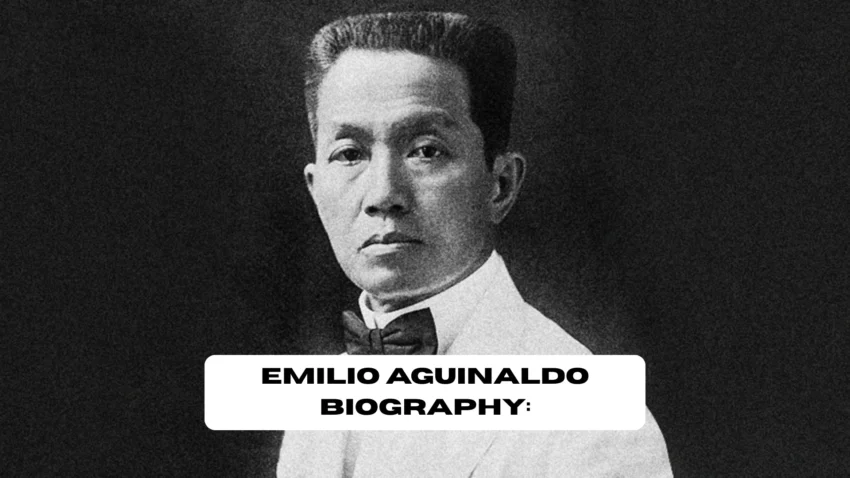
Emilio Aguinaldo y Famy is one of the most influential and controversial figures in Philippine history. Known as the first President of the Philippines, Aguinaldo played a central role in the country’s struggle for independence from Spanish colonial rule and later during the Philippine-American War. His leadership, decisions, and political legacy continue to be debated by historians, scholars, and Filipinos today.
This comprehensive Emilio Aguinaldo biography explores his early life, revolutionary activities, presidency, controversies, achievements, and lasting impact on the Philippines. Understanding Aguinaldo’s life provides valuable insight into the birth of the Philippine nation and the challenges of leadership during times of revolution.
Early Life and Education
Emilio Aguinaldo was born on March 22, 1869, in Cavite El Viejo (now Kawit), Cavite, Philippines. He came from a relatively well-off family, which allowed him access to formal education at a time when many Filipinos were denied such opportunities.
His father, Carlos Aguinaldo, served as the town’s gobernadorcillo (municipal head), while his mother, Trinidad Famy, managed the family’s agricultural affairs. Emilio was the seventh of eight children and showed leadership qualities from an early age.
Aguinaldo studied at Colegio de San Juan de Letran in Manila but was unable to complete his education due to a cholera outbreak that forced schools to close. Despite this, his early exposure to governance through his father and his natural leadership abilities shaped his political future.
Entry into Politics and the Philippine Revolution
Emilio Aguinaldo began his political career at a young age. At just 25 years old, he was elected Cabeza de Barangay, and later became Capitan Municipal (town mayor) of Cavite El Viejo.
In 1895, Aguinaldo joined the Katipunan, the secret revolutionary society founded by Andrés Bonifacio to overthrow Spanish colonial rule. When the Philippine Revolution erupted in 1896, Aguinaldo quickly distinguished himself as a capable military leader, winning several key battles against Spanish forces in Cavite.
His military success elevated his status within the revolutionary movement, eventually leading to a power struggle between Aguinaldo and Bonifacio.
Tejeros Convention and Leadership Controversy
One of the most controversial events in Emilio Aguinaldo’s biography is the Tejeros Convention held in March 1897. During this meeting, revolutionary leaders sought to establish a formal revolutionary government.
Aguinaldo was elected President, while Andrés Bonifacio was relegated to a lesser position. Bonifacio rejected the results, claiming the election was fraudulent. This internal conflict ultimately led to Bonifacio’s arrest and execution, an event that remains one of the most debated and criticized decisions of Aguinaldo’s leadership.
Despite the controversy, Aguinaldo emerged as the undisputed leader of the revolutionary government.
Exile in Hong Kong and the Pact of Biak-na-Bato
Facing increasing pressure from Spanish forces, Aguinaldo agreed to the Pact of Biak-na-Bato in December 1897. Under the agreement, Aguinaldo and other revolutionary leaders went into exile in Hong Kong in exchange for financial compensation and promised reforms from Spain.
While in exile, Aguinaldo used the funds to purchase weapons and plan for the continuation of the revolution. This strategic pause would later prove significant when global events shifted in favor of Philippine independence.
Return to the Philippines and Declaration of Independence
In 1898, the Spanish-American War broke out, dramatically changing the political landscape. With the help of the United States, Aguinaldo returned to the Philippines to resume the fight against Spanish rule.
On June 12, 1898, Emilio Aguinaldo proclaimed Philippine Independence in Kawit, Cavite. The Philippine flag was unfurled, and the national anthem was played for the first time. This historic moment marked a major milestone in Filipino nationalism, even though independence was not internationally recognized at the time.
First President of the Philippines
Emilio Aguinaldo officially became the first President of the Philippines on January 23, 1899, following the establishment of the First Philippine Republic in Malolos, Bulacan.
His presidency, however, was short-lived and fraught with challenges. The United States, having defeated Spain, decided to colonize the Philippines instead of granting full independence. This led to the outbreak of the Philippine-American War in 1899.
Philippine-American War and Capture
During the war, Aguinaldo led Filipino forces against the vastly superior American military. Despite early resistance, the revolutionary army struggled due to lack of resources and internal divisions.
In 1901, Aguinaldo was captured by American forces in Palanan, Isabela. Following his capture, he pledged allegiance to the United States, effectively ending organized Filipino resistance.
This decision further divided public opinion about Aguinaldo, with some viewing it as pragmatic and others as a betrayal of the revolutionary cause.
Later Life and Political Involvement
After the war, Emilio Aguinaldo retired from active military leadership but remained involved in Philippine politics. He ran unsuccessfully for president in 1935 against Manuel L. Quezon.
During World War II, Aguinaldo cooperated with Japanese forces, a decision that once again drew criticism. After the war, he was arrested but later granted amnesty.
Despite controversies, Aguinaldo lived long enough to witness the Philippines finally gain full independence from the United States on July 4, 1946.
Death and Legacy
Emilio Aguinaldo died on February 6, 1964, at the age of 94. His long life spanned Spanish, American, and Japanese occupations, as well as the birth of the modern Philippine nation.
Today, Aguinaldo is remembered as a revolutionary hero, a political leader, and a deeply complex historical figure. His home in Kawit is now the Aguinaldo Shrine, a national historical landmark.
FAQs
Q1: Who was Emilio Aguinaldo?
Emilio Aguinaldo was a Filipino revolutionary leader and the first President of the Philippines.
Q2: When was Emilio Aguinaldo born?
He was born on March 22, 1869, in Cavite, Philippines.
Q3: Why is Emilio Aguinaldo controversial?
He is controversial due to his role in the execution of Andrés Bonifacio and his cooperation with foreign powers.
Q4: What is Emilio Aguinaldo best known for?
He is best known for declaring Philippine independence and serving as the country’s first president.
Q5: When did Emilio Aguinaldo die?
He died on February 6, 1964.
Conclusion
The biography of Emilio Aguinaldo reveals a leader shaped by revolution, ambition, and complex political realities. As the first President of the Philippines, his contributions to Philippine independence are undeniable, even as his decisions continue to spark debate. Aguinaldo’s life story remains essential to understanding the Philippines’ journey toward nationhood and the difficult choices faced by leaders during times of upheaval.